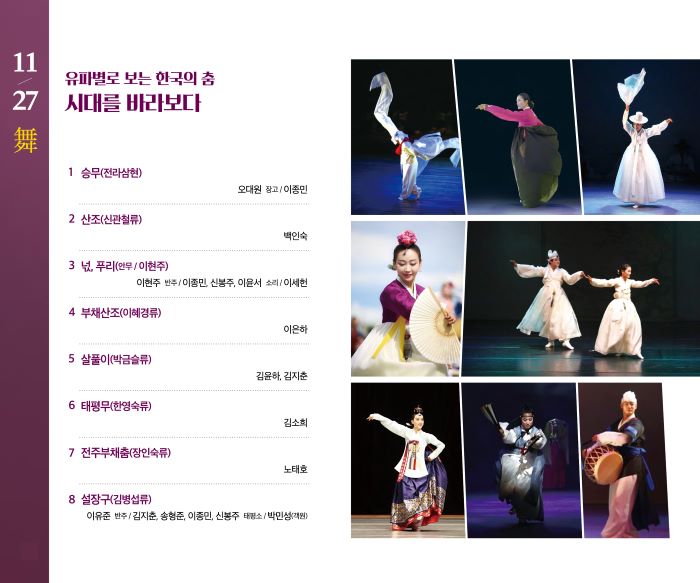
National Gugak Center Thursday Regular Program 'Korean Dance Through Different Perspectives'
...
Lee ByungJae(2025-11-26 08:47:29)
On the 27th, at 7:30 p.m., the Jeonbuk Provincial Government National Gugak Center (Director Yoo Young-dae) will hold a performance titled "Viewing Korean Dance through Various Genres: Reflecting on the Era" at the Myeongin Hall of the Hall of Korean Sound Culture for the second half of 2025.
This performance, the last stage of the 2025 Thursday regular series, was prepared by the dance troupe (artistic director Lee Hye-kyung). It will showcase a variety of traditional dances that preserve the unique spirit of Korean dance and continue its tradition. In addition, the audience can enjoy works that blend folk dance with contemporary sensibilities, providing an opportunity to glimpse the artistic depth and temporal expansiveness of Korean dance.
The program consists of a total of eight programs, including "Jeolla Samhyeonseungmu," "Shingwanchulryu Sanjo," "Neok, Puri," "Lee Hye-kyungru Buchae Sanjo," "Park Geum-sulryu Salpuri," "Han Young-sukryu Taepyeongmu," "Jang In-sukryu Jeonju Buchaechum," and "Kim Byeong-seobryu Seoljanggu."
The first program will be opened with "Jeolla Samhyeonseungmu." Seungmu is a traditional folk dance in Korea performed in ceremonial attire. Jeolla Samhyeon Seungmu is a dance performed to the rhythms of Jeolla Samhyeon Yukgak, a traditional music genre in Jeolla Province, and is a unique Seungmu registered as Jeonbuk's intangible cultural heritage. Members of the Odaewon will dance to the beat of Lee Jong-min's janggu.
The second program is "Shingwanchulryu Sanjo Dance" by Baek In-sook, the chief member of the dance troupe. This dance, performed to Sanjo music, is a spontaneous dance that is popular in the Honam region, known for its dynamic and free-flowing techniques.
Next is a creative dance based on the traditional "Neok, Puri." This piece, choreographed by Lee Hyeon-joo, features a reinterpretation of Seungcheonmu and Salpuri, combining the depth of tradition with a modern sensibility. Members Lee Jong-min, Shin Bong-joo, and Lee Yoon-seo will provide accompaniment, enhancing the performance with the sounds of the Changgeukdan.
The fourth program is "Lee Hye-kyungru Buchae Sanjo," featuring Lee Eun-ha, the chief member. This dance, performed by women holding fans to the accompaniment of gayageum Sanjo, showcases a unique breathing technique where the fan and hands move in unison.
The fifth program is "Park Geum-sulryu Salpuri," a genre of traditional dance that emphasizes the movements and breath of the dancers without using a handkerchief. Kim Yoon-ha and Kim Ji-chun convey the message of life and harmony through their bodies and breath.
Following this, the audience will witness Kim So-hee performing "Han Young-sukryu Taepyeongmu," a traditional dance designated as a national intangible cultural heritage. This dance is known for its simplicity, symmetry, and stability in its composition, showcasing refined beauty through restrained movements and a variety of footwork.
The seventh program features "Jang In-sukryu Jeonju Buchaechum," performed by No Tae-ho. This dance combines the rhythms of Jeonju's Sinaui Gagak, Jeonju Hapjukseon, and the Maejang of Boan with the energetic movements of Salpuri and the dignified and colorful fan dance.
The final stage is "Kim Byeong-seobryu Seoljanggu." Kim Byeong-seob, a master of Seoljanggu from Jeongeup, has refined the techniques and composition of Seoljanggu based on Jeongeup's Nongak throughout his life, establishing a foundation for modern Seoljanggu performances. The Kim Byeong-seobryu Seoljanggu, which continues his legacy, is currently one of the most actively transmitted genres, praised for its strong artistic value combining variations in rhythm and dynamic body movements. Members Lee Yoo-jun, Kim Ji-chun, Song Hyeong-jun, Lee Jong-min, and Shin Bong-joo will accompany the performance.